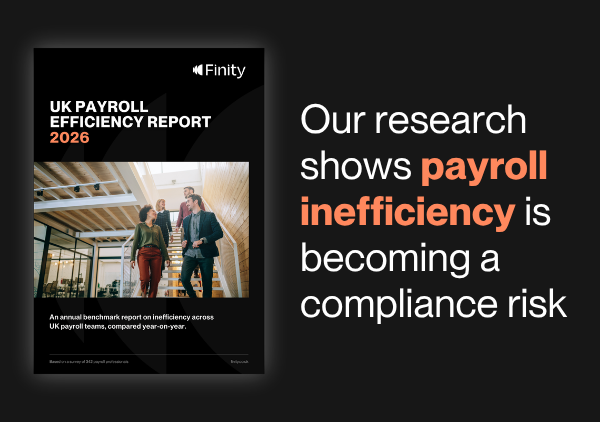
Payroll inefficiency is becoming a compliance risk. Our 2026 report shows why
By the time payroll runs, most of the risk is already there.
It sits in the work that happens before processing begins: manual corrections, re-keying data, chasing inconsistencies and making sure data matches across different platforms.
Our UK Payroll Efficiency Report 2026 shows the scale of the problem, based on insights from 342 payroll professionals:
- 9 in 10 payroll professionals experienced errors in the last year
- 77% lose up to 11 hours every week to inefficient systems or processes
- 68% report payment delays, up from 43% in 2025
- 70% run payroll across multiple systems
Payroll teams are being asked to deliver accuracy, speed and accountability while working around fragmented systems and manual processes. With compliance under greater scrutiny, the cost of inefficient payroll processes now goes beyond lost time. It affects accuracy, accountability and confidence.
Where payroll risk really starts
Payroll risk builds when teams have to work around gaps in the process.
Each step may feel manageable on its own, but together they create the conditions for mistakes, delays and uncertainty. That’s why nearly half of payroll professionals say human error during manual processing is the most common cause of payroll mistakes, while 78% of organisations still rely on manual work.
The issue is bigger than manual processing alone. 63% of organisations report problems with data transfers between systems, and with 70% typically relying on 3.2 systems to run payroll, fragmentation is now a widespread risk.
Payroll professionals are feeling the impact, with 77% losing up to 11 hours every week to inefficient systems or processes, 91% dissatisfied with their current payroll process, and 27% feeling overwhelmed by payroll admin.
Compliance expectations are changing
Payroll accuracy has always been a baseline expectation, but the need for evidence and accountability is changing.
As scrutiny increases across supply chains, payroll teams are under growing pressure to show that payroll processes are reliable, transparent and properly controlled.
As Samantha Hurley, Managing Director at APSCo, explains in relation to recruitment and the recently introduced Joint and Several Liability (JSL) reform:
“As scrutiny across labour supply chains continues to evolve, the ability to demonstrate reliable and transparent payroll processes will become increasingly important.”
This is why inefficiency can no longer be treated as an operational frustration. When payroll data is adjusted repeatedly, moved between systems or manually reconciled, it becomes harder to explain how the final outcome was reached.
The role of better payroll infrastructure
Modern payroll infrastructure should reduce the manual work that creates risk in the first place.
That means bringing data, processing and payments into a more connected workflow, so teams spend less time re-keying information, chasing inconsistencies and second-guessing outputs.
For payroll teams, the benefit is more control, better visibility and greater confidence that the process can stand up to scrutiny.
Alongside this, independent compliance frameworks such as SafeRec are helping organisations evidence how payroll has been calculated and if taxes have been accurately disclosed and paid to HMRC.
Sebastian Sauca, Co-Founder and CEO at SafeRec, comments:
“Businesses too often overlook the payroll software they choose, thinking that all payroll softwares are equal. It couldn’t be further from the truth. Payroll software that has integration with independent auditors such as SafeRec is now becoming a must in world that moves more toward compliance and accountability.”
Together, connected payroll systems and independent audit frameworks address both sides of the challenge: reducing the inefficiencies that create errors, and providing the transparency needed to manage compliance risk.
What payroll leaders should take from the report
The starting point is understanding where time and control are being lost.
That means asking how many systems are involved in payroll, where data is being moved or re-keyed, which checks still rely on manual intervention, where delays usually appear, and how manageable the current process feels for the payroll team.
Those answers will quickly show whether inefficiency is creating more than an admin burden. In many cases, it’s already creating compliance risk.
Read the UK Payroll Efficiency Report 2026 for the full findings from our survey of 342 payroll professionals.